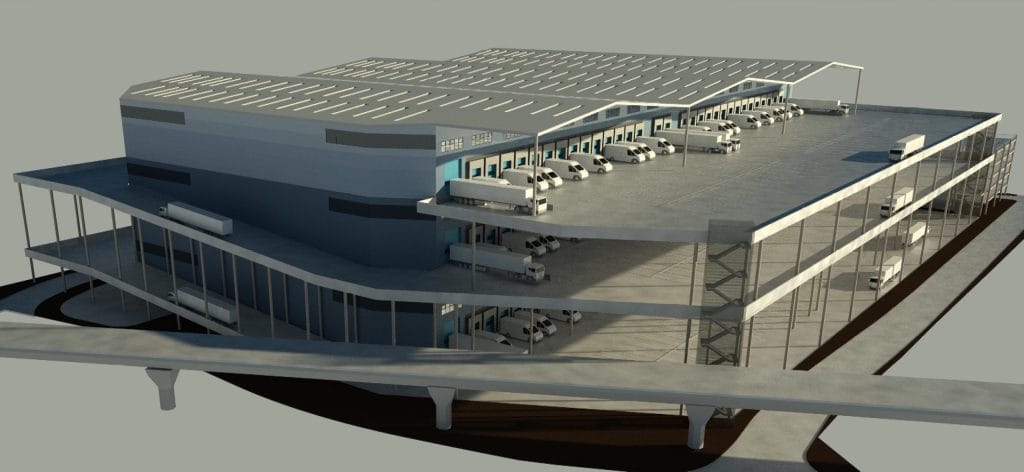
Multi-storied factories and warehouses have been mushrooming because the land costs today are touching sky high. It is very important, therefore to know about the right flow of materials to attain an optimum layout of a multi-storey factory.
The future of multi-storey manufacturing or warehousing real-estate
In the light of new production requirements and the need to avoid wasting precious virgin soil, the single storey landscaper factory or warehouse buildings must be reconsidered.
Of course, there are types of industry (one for all, the heavy metalworking industry) that must necessarily be located entirely at ground level. The bulk and weight of processing machinery and manufactured goods is certainly incompatible with a multi-storey distribution of departments and the handling of goods produced.
But there are many other types of processing and/or warehousing for which the multilevel building typology could become topical again.
It is a question of rethinking this type of building starting with the architectural design, which must be conceived around the flows of people and goods and must concentrate efforts – where possible – on a verticalization of the production process.
Excessive land consumption, a phenomenon that has become a major issue in urban areas, must be curbed, and the study of multi-storey building solutions can be an important aid.
A cultural and design effort is needed to plan productive spaces, with sustainable costs, that go in this direction. The architectural design of the building must be a suit modelled around work flows, suitably supported by increasingly flexible and efficient lifting equipment.
Pros of multi-storey warehouses & factories
- Vertical space utilization promotes the efficient use of limited land resources, a critical factor in urban planning. Multiple floors deliver greater storage capacity whilst occupying less land space.
- Goods are organized and stored effectively on different floors to support logistics operations. When combined with advanced technology to enhance accessibility between floors, this enables efficient inventory management and movement of goods.
- Less land is required, which delivers significant cost savings and long-term cost efficiencies. Operational costs for storage, handling and maintenance can also be reduced.
- Transportation costs are lower as the warehouses / factories are located near prime market centers to meet customer demands and strict delivery times. They improve the distribution network and are ideal for last-mile delivery, supporting fast turnover.
- Reducing the number of single-level facilities and minimizing land consumption contributes to a smaller environmental footprint.
- The urban setting provides proximity to a larger workforce that can access the facility by public transport and has the potential to be part of mixed-use developments.
Addressing architectural and engineering challenges
Building multi-storey warehouses requires meticulous planning, design, and construction processes. Due to the complexity and urban location of such projects, planning, design and construction programmes are challenging and require in-depth coordination across the project timeline.
Understanding how each floor of the building is to be used, addressing the challenges of multi occupancy and how floor levels are to be accessed either by ramps and /or goods lifts are key design decisions.
Building structure
Multi-storey logistics buildings require distinct structural arrangements to resist significant horizontal and vertical loads, from storing palletised goods to racking systems and moving vehicles such as pallet trucks and forklifts. The selection of a column grid is a balance between achieving a column-free area, which is highly desirable, against significant structure depths to achieve long clear spans.
The upper floors may also need to consider the support of material-handling equipment (MHE) systems (e.g. robotics) that demand a high level of surface regularity and require a stiff supporting structure to limit in-service deflections. Careful consideration at both the design and construction stages is therefore necessary.
Elevational treatment
Warehouses in urban settings must respond to their immediate surroundings in ways buildings in industrial parks do not. Landscape features are critical to integrating and harmonizing multi-storey warehouses with the urban realm, façade, and elevation treatment. This helps to address the scale and nature of neighboring buildings and the proximity and interface of pedestrians and other street users. Together with aesthetic and contextual considerations, several other design aspects set urban logistic facilities apart from their out-of-town counterparts when considering elevational treatment.
Acoustically, the façade needs to address the escape of operational noise, particularly in mixed-use areas where there may be residential neighbors and the ingress of street noise may be a factor in the design of office elements. The proximity to heavy traffic within the urban setting can also impact ventilation strategies, with fewer opportunities for window openings in office spaces.
Access to multiple levels
Vehicles ideally require direct access to loading docks and/or vertical transportation systems to facilitate the seamless movement of goods to/from and within the logistics facility.
Upper floors can be accessed via goods lifts in these warehouses. It’s important to consider the challenges of multi-occupancy warehouses, where the lifts are shared between units and may require regular maintenance. Upper levels can, therefore, be less desired than ground-floor space due to the inconvenience of loading and unloading goods by lifts. Lift access may not be the most efficient or preferred operational outcome for occupiers and may present potential security risks, particularly in multi-tenant facilities.
Fire safety
Built on constricted sites in urban settings, multi-level and multi-tenanted storage facilities increase fire safety risks. Robust fire safety is therefore critical to addressing these risks and the unique challenges presented.
Understanding the risks and how to mitigate them is critical to developing and implementing an appropriate fire strategy. This involves providing a safe means of escape for building occupants by addressing extensions in travel distance while providing identifiable escape routes. It’s also vital to consider the risks of materials introduced in the building design, such as green living walls and green roofs, whilst adopting materials that resist fire spread. Achieving appropriate levels of structural fire resistance and active and passive fire protection measures in buildings can help safeguard building users, rescue services and the wider community.
The future of logistics
Multi-storey warehouses present a forward-thinking approach to warehouse management, streamlining logistics operations. Combining innovative design, advanced technologies and sustainability considerations, these warehouses can shape the future of logistics by targeting limited land availability and increasing urbanization.
The world is rapidly changing, and the fabric of production is undergoing profound changes. Even the ways of thinking about and realizing workspaces cannot remain forcibly anchored to the building model that has been imposed since the 1980s, they must evolve virtuously. This too is ESG.